Who this guide is for
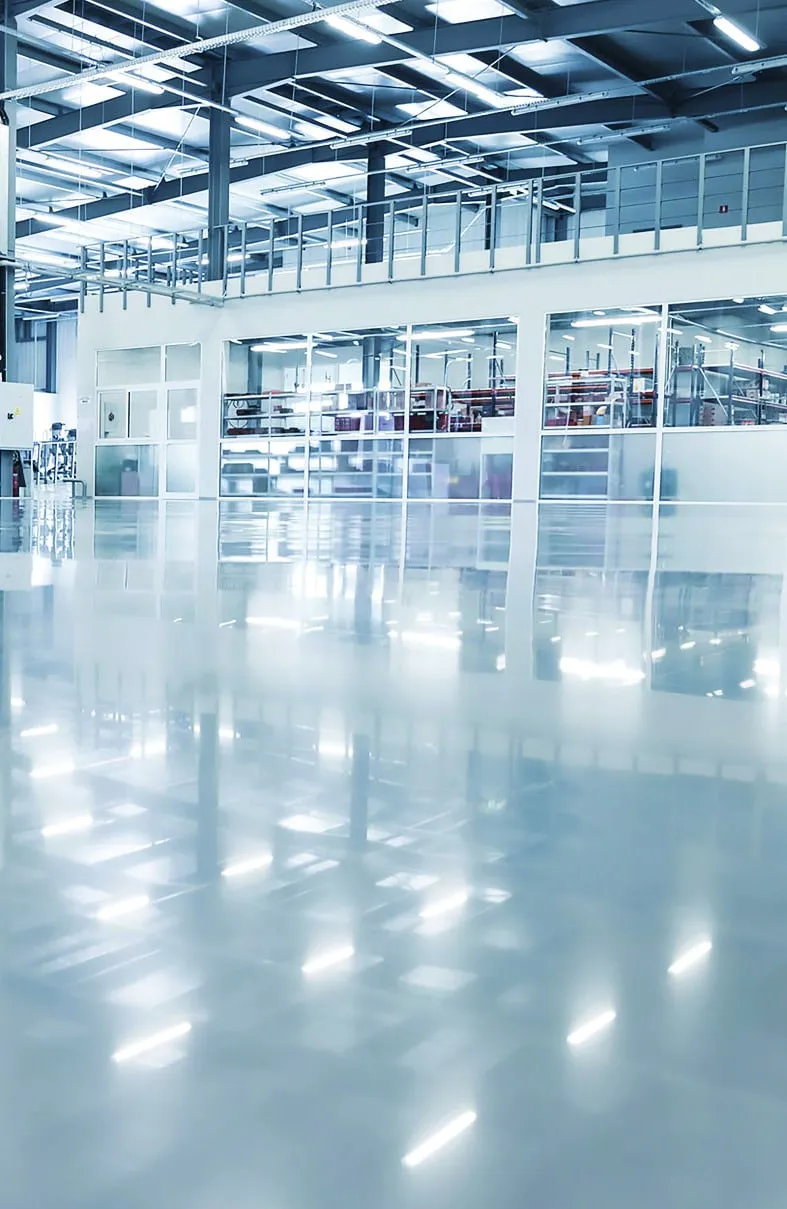
For managers and maintenance teams looking after epoxy and resin floors in food production, manufacturing, workshops and service garages, warehouses and showrooms. The guide covers epoxy and resin floors, epoxy terrazzo and painted epoxy.
For these floors the manufacturer’s table mainly specifies High Performance pads, with Regular 400 or the tougher Heavy Duty 400 for restoring.
How to recognise your floor
- Epoxy and resin floors: a seamless, smooth surface, often in one colour, glossy or satin. Typical in production, warehouses and workshops.
- Epoxy terrazzo: stone or glass chips set in resin and ground to a smooth surface.
- Painted epoxy: a thin coat of colour on concrete; where it has worn, grey concrete shows through.
- No coating: if there is no resin layer, just bare or polished concrete, follow the concrete guide.
The epoxy programme
The tables follow the manufacturer’s table of methods. Epoxy and resin floors get the full programme, from restoring to burnishing.
| Job | Pad | Machine |
|---|---|---|
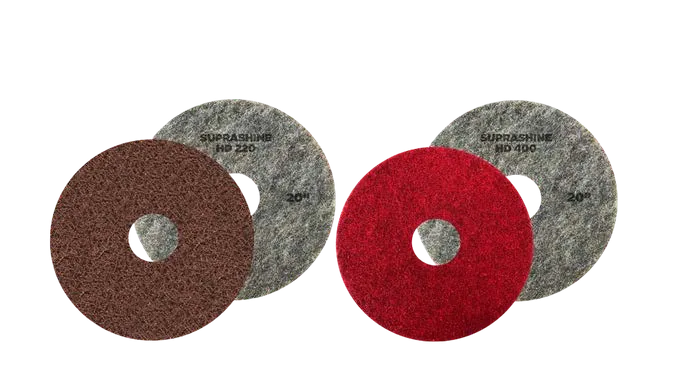
| Restore and stripdifficult | RG 400redorHD 400red | Scrubber-dryer or single-disc machine |
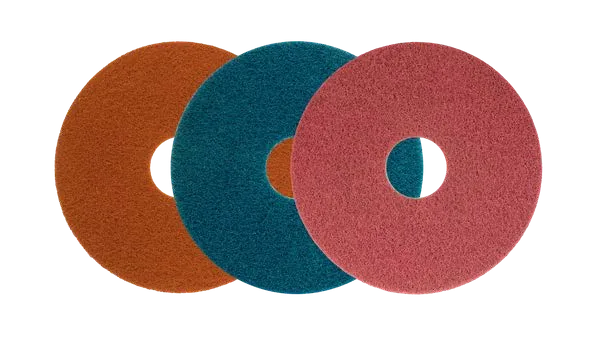
| Deep cleaningmedium | HP 800orange | Scrubber-dryer or single-disc machine |
| Gloss upgrademedium | HP 800orangeand/orHP 1800blue | Scrubber-dryer or single-disc machine |
| Daily maintenanceeasy | HP 3500pinkorHP 1800blue | Scrubber-dryer or single-disc machine |
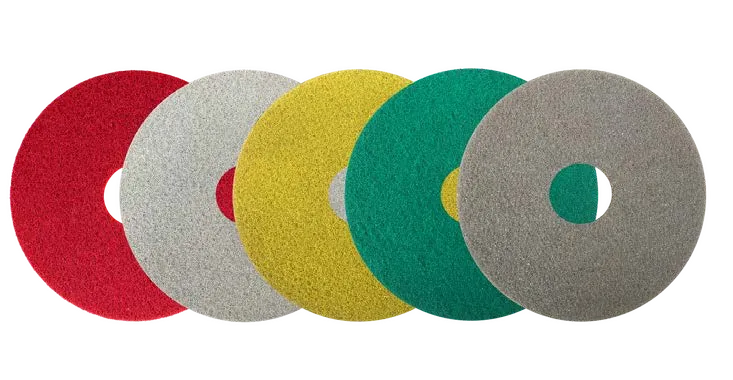
| High-speed burnishingoptional | RG 8000silverorHP 3500pink | High-speed burnisher |
For epoxy terrazzo and painted epoxy, the manufacturer does not specify restoring with coarse pads. Deep clean with HP 1800, upgrade the gloss with HP 1800 and/or HP 3500, and maintain daily as for other epoxy floors.
| Job | Pad | Machine |
|---|---|---|
| Deep cleaningmedium | HP 1800blue | Scrubber-dryer or single-disc machine |
| Gloss upgrademedium | HP 1800blueand/orHP 3500pink | Scrubber-dryer or single-disc machine |
| Daily maintenanceeasy | HP 3500pinkorHP 1800blue | Scrubber-dryer or single-disc machine |
| High-speed burnishingoptional | RG 8000silverorHP 3500pink | High-speed burnisher |
Which step, when
- Restore (difficult): very dirty, damaged or old floors, stains and scratches. RG 400 or HD 400.
- Deep cleaning (medium): periodically, when routine cleaning is no longer enough. HP 800.
- Gloss upgrade (medium): intensive gloss upgrade and closing the pores. HP 800 and/or HP 1800.
- Daily maintenance (easy): routine cleaning with water only. HP 3500 or HP 1800.
- Burnishing (optional): daily or periodic, with a high-speed burnisher, for even more gloss. RG 8000 or HP 3500.
Once the floor is restored, you stay on the daily pad most of the time and go back to the lower steps only when needed, for example after a spell of heavier soiling.
What you need
- The scrubber-dryer or single-disc machine you already own.
- A velcro pad holder, which the manufacturer recommends for best results.
- Pads in your machine’s size: 5" to 28", and 36" and 48" for High Performance and Heavy Duty.
- A high-speed burnisher for optional burnishing.
- Clean water, no detergent.
Step by step
Restoring old or worn floors
- Sweep the floor and remove coarse dirt.
- Fit RG 400 or HD 400 to a single-disc machine or scrubber. HD 400 is made of a tougher material, for difficult cases and surface preparation.
- Work with water, in several passes, until the surface is evenly clean.
- Pick up the dirty water with a scrubber-dryer and check the result.
Deep cleaning and gloss
- Deep clean the floor with HP 800.
- For more gloss, continue with HP 1800. This step is optional.
Daily maintenance
- Fit HP 3500, or HP 1800 in tougher conditions, centred on the velcro holder.
- Clean with water only, one pass a day. The pad cleans and polishes at the same time.
- When needed, burnish with RG 8000 or HP 3500 on a high-speed burnisher, with a slightly wet pad.
- After work, rinse the pad and let it dry.
Unless it is an extreme case, the manufacturer recommends water only for every job, from restoring to maintenance.
In practice: food industry
In one of the manufacturer’s case studies, a food plant with an old epoxy floor wanted chemical-free cleaning to prevent contamination. The programme was restoring with RG 400 or HD 400, then deep cleaning with HP 800, and an optional gloss upgrade with HP 1800. All with water only.
Epoxy floors in retail follow the same pattern as concrete: in the case study, high-traffic supermarkets cleaned daily with HP 3500, and with HP 1800 in tougher conditions.
Common mistakes
- Hybrids on epoxy. Hybrids are for concrete, terrazzo and natural stone. For restoring epoxy, the manufacturer specifies RG 400 or HD 400.
- Coarse pads on painted epoxy or epoxy terrazzo. The manufacturer does not specify restoring for these floors; start with HP 1800.
- Detergent in a food plant. Cleaning with water only leaves no detergent on the floor, which helps prevent contamination.
- HP 3500 for restoring. HP 3500 is a daily maintenance pad. Restore worn floors first with RG 400 or HD 400, then deep clean with HP 800.
- Burnishing dry. Slightly wet the pad on a burnisher: no dust, longer pad life and a better gloss.
- The wrong pad size. The pad must match the machine’s holder. Check the sizes.
Next step
Find the pad, sequence and size for your machine in the pad finder for epoxy; for epoxy terrazzo, choose epoxy terrazzo and painted epoxy. If you run a food plant or the floor is badly worn, send us an inquiry describing the floor and the machine.