Who this guide is for
This guide is for facility managers, cleaning contractors and maintenance teams looking after concrete floors in warehouses and logistics centres, shops and supermarkets, production halls, showrooms and garages. It covers plain industrial concrete and ground, polished concrete.
If the concrete has an epoxy or other coating that forms a film, follow the epoxy floor guide. Terrazzo and natural stone follow a very similar programme; the differences in restoration are in the marble, granite and terrazzo guide.
How to recognise your floor
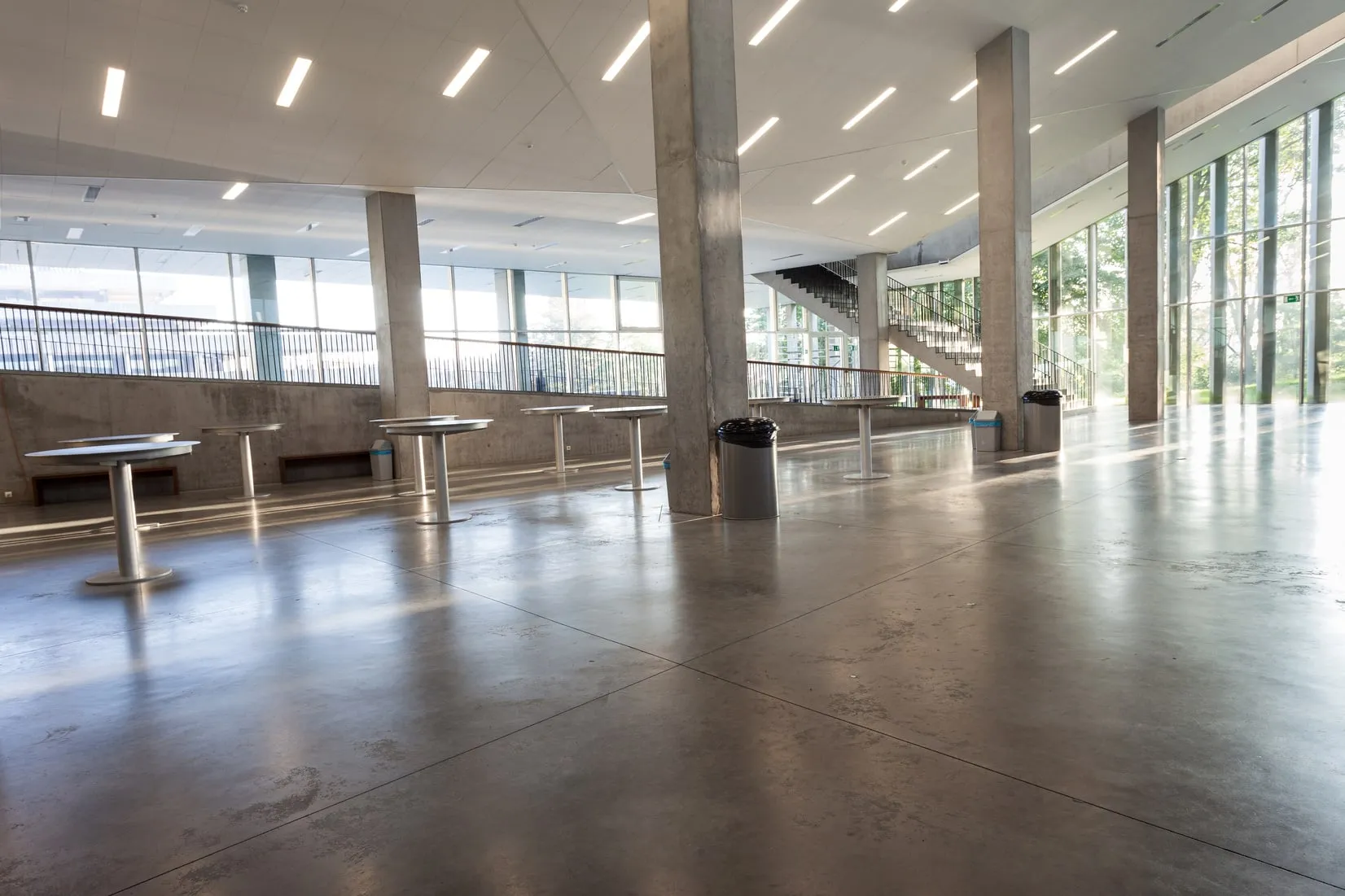
- Polished concrete: a smooth, even surface with a sheen, often with the aggregate visible. There is no film of coating on top that could peel.
- Industrial concrete: matt and more porous, often with forklift marks, stains and dust.
- Damaged concrete: deep or light scratches, stains, efflorescence (white deposits) or orange peel, a wavy, rough surface.
- Coated concrete: the shine comes from a layer on top that wears or peels in traffic lanes. For these floors, see the epoxy guide.
The concrete programme
The programme follows the manufacturer’s table of methods per floor type. Start where your floor is today: restore a damaged floor first, then move on to deep cleaning and gloss upgrade, until only daily maintenance is left.
| Job | Pad | Machine |
|---|---|---|
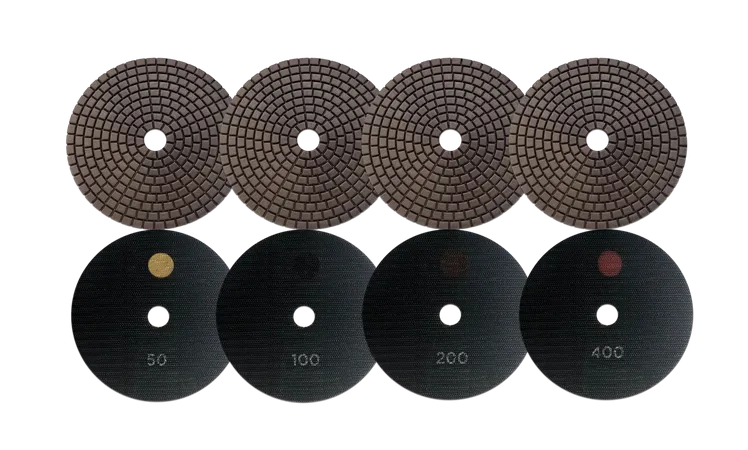
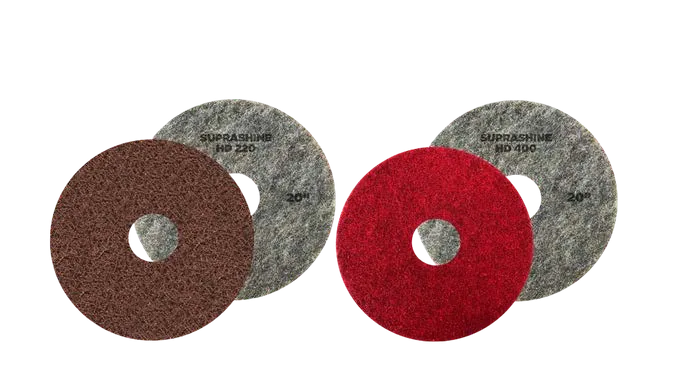
| Restore and stripdifficult | Hybrids 50–400(in sequence)orHD 400redorHD 220brown | Hybrids: scrubber, at least 40–45 kg. HD: low- or high-speed machine. |
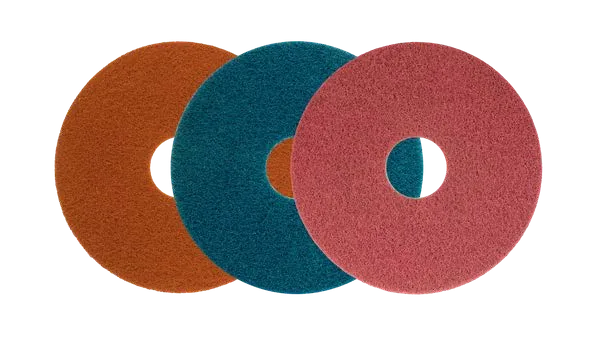
| Deep cleaningmedium | HP 800orange | Scrubber-dryer or single-disc machine |
| Gloss upgrademedium | HP 800orangeand/orHP 1800blue | Scrubber-dryer or single-disc machine |
| Daily maintenanceeasy | HP 3500pinkorHP 1800blue | Scrubber-dryer or single-disc machine |
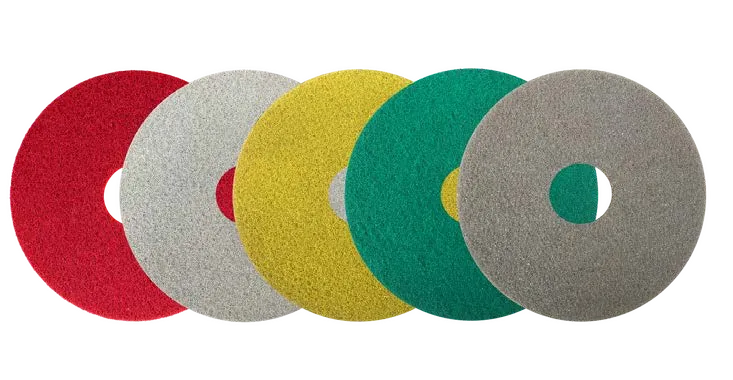
| High-speed burnishingoptional | RG 8000silverorHP 3500pink | High-speed burnisher |
When restoring with Hybrids, choose the starting grit by the floor’s condition: start with 50 or 100 for deep scratches and orange peel, with 200 or 400 for light ones, then continue in sequence up to the grit you want. Heavy Duty 400 and 220 are for surface preparation and stripping old coatings with water only.
What you need
- The scrubber-dryer or single-disc machine you already own. For restoring with Hybrids, a scrubber.
- A velcro pad holder, which the manufacturer recommends for best results.
- Pads in your machine’s size: 5" to 28", and 36" and 48" for High Performance and Heavy Duty.
- A high-speed burnisher for optional burnishing.
- Clean water, no detergent.
Step by step
Restoring a damaged floor with Hybrids
- Sweep the floor and remove coarse dirt.
- Space five Hybrids evenly on a 20" carrier pad and fit it to the scrubber. Use a pressure of at least 40–45 kg.
- Make 3–4 passes with water, each in the opposite direction to the last, overlapping 25–50 mm.
- Autoscrub between grits and check that the cut is even.
- Continue in sequence up to the grit you want. According to the manufacturer, a densifier may be needed on some concrete floors.
Deep cleaning and gloss upgrade
- Deep clean the floor with HP 800. Make more passes on very dirty floors.
- Upgrade the gloss with HP 800 and/or HP 1800: on more worn floors, start with HP 800 and continue with HP 1800.
Daily maintenance
- Fit HP 3500, or HP 1800 in tougher conditions, centred on the velcro holder of a scrubber-dryer or single-disc machine.
- Fill the tank with water only.
- Clean as you always have, one pass a day. The pad cleans and polishes at the same time.
- For even more gloss, burnish occasionally or daily with RG 8000 or HP 3500 on a high-speed burnisher, with a slightly wet pad.
- After work, rinse the pad and let it dry.
With High Performance pads, the manufacturer states that results can be seen in as soon as 10 days, with maximum gloss usually reached after 30+ days of routine cleaning.
In practice: supermarkets
In one of Superabrasive’s case studies, high-traffic retail stores with terrazzo, polished concrete, natural stone and epoxy floors wanted bright floors every day. The answer was a single pad: HP 3500 for daily cleaning, and HP 1800 in tougher conditions. The result was a higher gloss, very good cleaning and a consistent look.
In a second retail case, the floor was first deep cleaned with HP 800 and the gloss then upgraded with HP 1800.
Common mistakes
- Detergent out of habit. The diamonds work mechanically, so the manufacturer recommends detergent only in extreme cases.
- Too fine a pad on a damaged floor. HP 3500 is a daily maintenance pad. Remove scratches, stains and orange peel first, by restoring or deep cleaning.
- Skipping grits with Hybrids. Continue in sequence to the grit you want, and check between steps that the cut is even.
- Hybrids on a high-speed machine, or with too little pressure. Hybrids are for low-speed machines only, scrubbers for best results, at no less than 40–45 kg.
- Burnishing dry. Slightly wet the pad on a burnisher: no dust, longer pad life and a better gloss.
- Expecting full gloss after one pass. The gloss builds with routine cleaning and usually peaks after 30+ days.
- Pad off-centre on the holder. Place the pad exactly in the centre of the velcro holder and press it down all over.
Next step
The quickest way to the right pad and size for your machine is the pad finder for concrete. If the floor needs restoring, or you are not sure what state it is in, send us an inquiry describing the floor and the machine. We suggest the pads, sequence and size, and send you an offer.